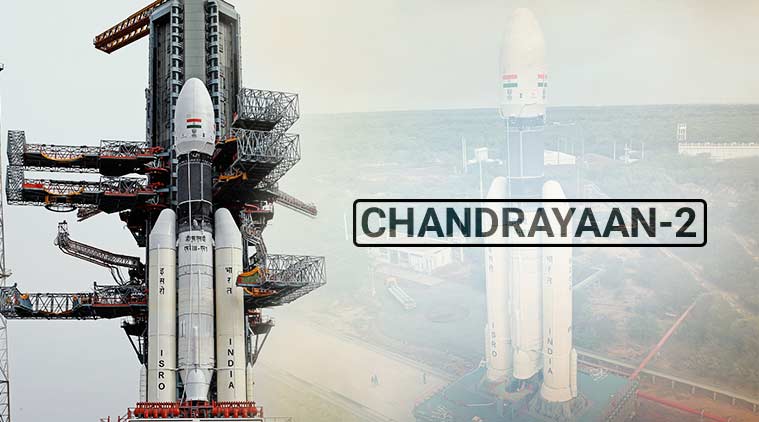
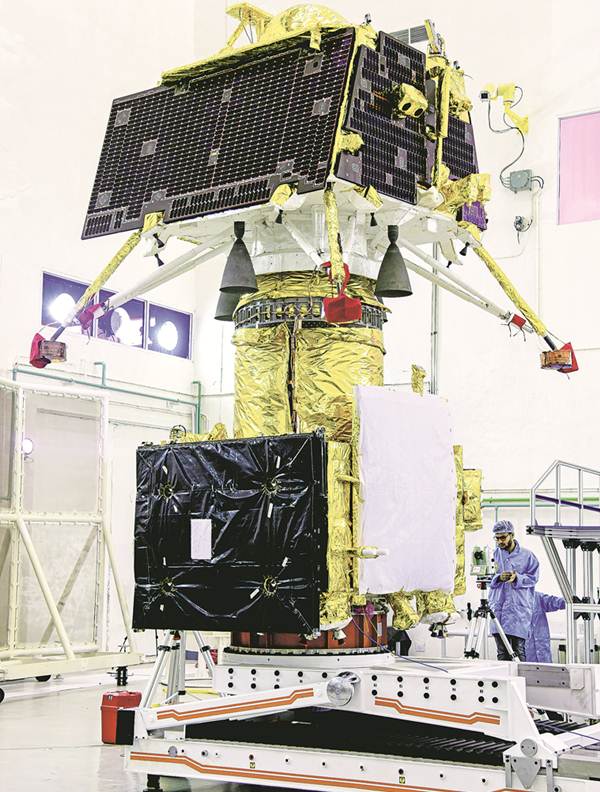
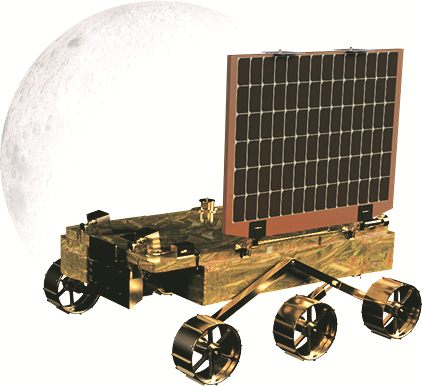
Chandrayaan-2 is India’s second lunar probe, and its first attempt to make a soft landing on the Moon. It has an Orbiter, which will go around the Moon for a year in an orbit of 100 km from the surface, and a Lander and a Rover that will land on the Moon. Once there, the Rover will separate from the Lander, and will move around on the lunar surface. Both the Lander and the Rover are expected to be active for one month.
The Orbiter, Lander and Rover are each fitted with several instruments to carry out experiments. While Chandrayaan-2 is expected to yield a wealth of new information about the Moon, apart from demonstrating ISRO’s new capabilities, here are a few things that are likely to be discussed the most in the coming days.
How is Chandrayaan-2 different from Chandrayaan-1?
Chandrayaan-2 is ISRO’s first attempt to land on any extraterrestrial surface. One of the instruments on Chandrayaan-1, the Moon Impact Probe or MIP, had been made to land on the Moon, but that was a crash-landing, and the cube-shaped instrument, with the Indian Tricolour on all sides, was destroyed after hitting the lunar surface. The Lander and Rover on Chandrayaan-2, on the other hand, are meant to make a soft landing, and to work on the Moon.
How has the landing been scheduled?
The Lander and Rover were scheduled to descend on September 6, more than 50 days after the launch early Monday (July 15). The launch, however, got delayed due to technical issues. Most of the other lander missions have taken considerably less time to reach the Moon. The human missions, in fact, all landed within three to four days. Chandrayaan-1 had taken 12 days to enter the Moon’s orbit. The time taken to reach the Moon is dictated by many factors, such as the strength of the rocket carrying the spacecraft, the nature of experiments to be carried out, and the position of the Moon in its orbit.

How is a soft landing achieved?
In terms of technology, landing is the most complicated part of the Mission. Travelling at nearly 6,000 km per hour at the time of their ejection from the Orbiter, the Lander and Rover would have to slow down to roughly about 3 km/hr. This 15-minute exercise will mark the “most terrifying moments” for the mission, as ISRO chairman K Sivan put it. The Moon does not have an atmosphere to provide drag, so the use of parachute-like technologies to slow down the Lander cannot be used. Instead, thrusters will be fired in the opposite direction to slow it down. All this while, the Lander will also be imaging the lunar surface to look for a safe site to land.
What new information will the Mission look for?
South Pole: Chandrayaan-2 is attempting to go where no spacecraft has gone before — to the south pole of the Moon. There have been 28 landings on the Moon so far, including six human landings. All these landings have taken place in the equatorial region. Studies have, however, indicated that the unexplored polar regions could hold much greater scientific potential.
Launch videos
Follow My Blog
Get new content delivered directly to your inbox.
 Mission Chandrayan II